
The Voting Rights Act is an essential piece of the legislative effort to end more than a century of terrorist violence aimed at subverting democracy, the rule of law, and the defense of the rights of all.
The question of our moment, sadly, seems to be whether human rights, freedom, and justice matter more than the lust of a few people of terrible character to accumulate money and power and to place themselves above the law. This question was answered, in 1776, when the independence of a new republic was declared, the sins of an abusive monarchy laid out as an indictment before the court of history, and all people were, for the first time, proclaimed to be endowed with unalienable rights.
The whims of power were not to govern, but could be a warning of the threat posed by criminal powerholders. For that reason, power would be vested in laws and institutions, and in the people themselves, along with the private associations through which organize and cooperate, and the press who provide them with needed facts and evidence, so they can be informed citizens who steer the republic.
Elections would ensure, in principle, that abusive, incompetent, or otherwise untrustworthy officeholders would be replaced. The new Constitution would create a separation of powers, provide for removal of corrupt officials, guarantee habeas corpus and due process, prevent tyrannical abuses like ex-post facto laws, and prohibit self-dealing and corruption.
The Constitution was flawed, in terrible and tragic ways, in some of its substance, but in its structure, it provided means for improving or eliminating those provisions by amendment. The first ten amendments were approved along with the Constitution itself, as a Bill of Rights. This was the foundational legal bulwark against tyrannical abuses of power, setting the clear standard that rights have primacy over power, always.
The Constitution was a mission statement for a participatory system of self-government we are still perfecting, in which rights and justice would prevail over the sinister temptations of power on those of weak character.
The first draft of the Declaration of Independence called human enslavement a “cruel war against human nature itself”, an “execrable commerce”, and an “assemblage of horrors”. It accused King George and the British Empire of corrupting all of American society through this evil, weakening it to rule over it more easily.
That evil would eventually be outlawed throughout the United States by the 13th Amendment to the Constitution. By that time, however, multiple overlapping campaigns of terrorist violence—aimed at defending the cult of torture and tyranny and rejecting the Constitution’s mandate the U.S. be a nation of immigrants (Article I, Sections 8, 9)—had affected cities and small communities throughout the country.
In the 1860s, as the nation moved toward abolition of the evil of enslavement, terrorist conspirators sought to split the union and then waged war against their fellow Americans, killing hundreds of thousands. The terrorists would be defeated and would surrender in the village of Appomattox Court House, but they would continue to wage a campaign of terrorist violence.
Abraham Lincoln was one of the victims of that terrorist violence. He was killed by conspirators who wanted to prevent the “new birth of freedom”, in which all Americans would be free human beings with unalienable rights, as promised.
The 13th, 14th, and 15th Amendments were supposed to end the cult of torture and terror, make human enslavement illegal and impossible, and ensure the terrorist cult could not govern, because all people would be able to vote. The post-war amendments were to be enforced by acts of Congress.
The historian Heather Cox Richardson writes:
In 1870, Congress established the Department of Justice to do just that. Reactionary white southerners had been using state laws, and the unwillingness of state judges and juries to protect Black Americans from white gangs and cheating employers, to keep Black people subservient. White men organized as the Ku Klux Klan to terrorize Black men and to keep them and their white allies from voting to change that system. In 1870 the federal government stepped in to protect Black rights and prosecute members of the Ku Klux Klan.
She also notes that nearly a century after the Civil War, terrorist violence was still used to punish basic civic engagement:
In 1961 the Student Nonviolent Coordinating Committee (SNCC) and the Council of Federated Organizations (COFO) began intensive efforts to register voters and to organize communities to support political change. Because only 6.7% of Black Mississippians were registered, Mississippi became a focal point, and in the “Freedom Summer” of 1964, organized under Bob Moses, volunteers set out to register voters. On June 21, Ku Klux Klan members, at least one of whom was a law enforcement officer, murdered organizers James Chaney, Andrew Goodman, and Michael Schwerner near Philadelphia, Mississippi, and, when discovered, laughed at the idea they would be punished for the murders.
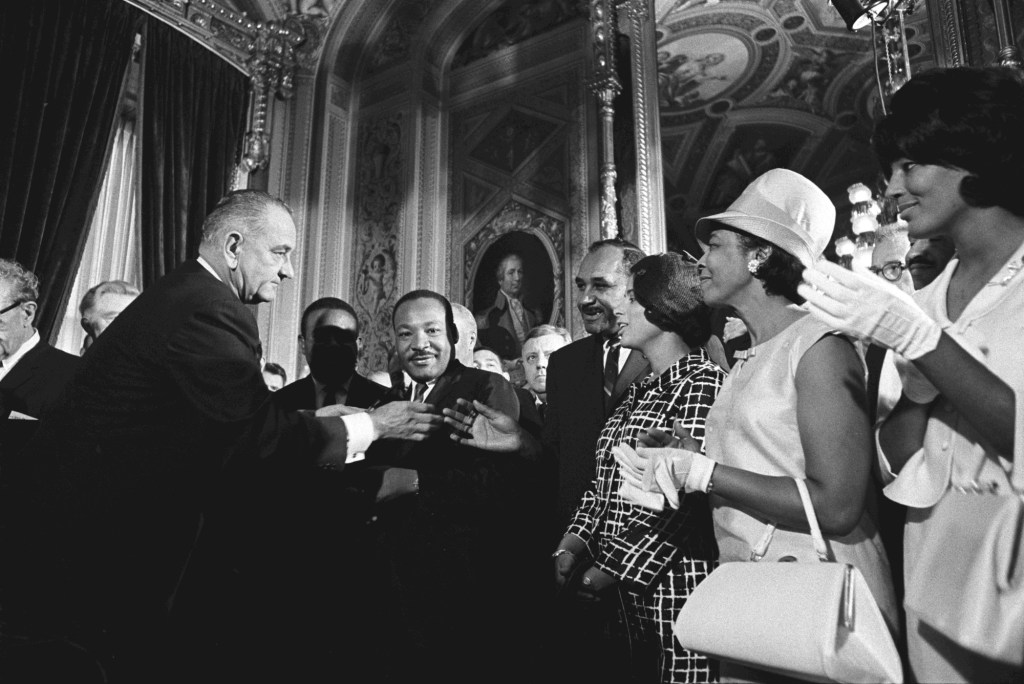
Sixty years ago this week—on August 6, 1965—the Voting Rights Act became law. It was needed to ensure that corrupt officials, working in line with this long-running ideology of anti-democracy terror, could not structure election law to exclude any American citizens. The Rev. Martin Luther King, Jr., described the new law as “a triumph for freedom as huge as any victory that’s ever been won on any battlefield,” adding “today we strike away the last major shackle of… fierce and ancient bonds.”
In our time, the effect of radicalizing rhetoric and attacks on voting rights aligning with extremist violence is a very real concern.
- Neo-Nazi groups are claiming support from the President of the United States, who once called racist extremists who attacked Charlottesville “very fine people” and this year has pardoned some of their fellow travelers for openly seditious violence against the U.S. Congress and police defending the Constitutional process of vote counting, and even hired alleged Nazi sympahizers to work in his administration.
- Mr. Trump has also begun reinstating statues honoring Confederate leaders—the very people who declared war against their own country and carried out countless acts of terrorist violence, killing hundreds of thousands of Americans, in defense of human enslavement.
- The President has issued an unconstitutional memorandum seeking to authorize the use of military force against Americans protesting his policies.
- Mr. Trump’s rhetoric has also been cited as inspiration for extremist violence, such as the assassination of former Minnesota House Speaker Melissa Hortman and her husband.
- It was also a violent extremist who believed in white supremacist “race war” ideology, who was convicted and sentenced for traveling to Minnesota in 2020 and firing sniper rounds into a police precinct, in hopes of triggering a new American civil war.
The Voting Rights Act ensures all of us vote in elections that are free and fair, undiminished by corrupt attempts to manipulate outcomes or punish dissent. It does this both to ensure minority groups and dissident views are not effectively outlawed by self-serving authoritarians and to dissolve the root structure of the terrorist movement that has worked against democracy in America since the 1830s.
If anyone’s right to vote is degraded or diminished, then all of us are less free.
 The Faithful Citizen